
How This Muscle Relaxant Blocks Nerve-Brain Discomfort
Understanding Muscle Spasms and Discomfort
A. What Are Muscle Spasms?
The involuntary contractions of muscles are called muscle spasms. Muscle Spasms are often referred to as cramps, also known as a charley horse. These episodes can result in excruciating pain and a physical feeling of tightness or a knot of a hard substance in the involved territory. They may be brief but very excruciating. The most frequent ones are dehydration, electrolyte disturbance, muscle fatigue, and inadequate circulation. To alleviate symptoms, stretching, massage, and the application of a muscle relaxant may be used to ease the knot which is tightened and get the person to relax. In order to avoid frequent discomfort, it is important to address the root cause of the problem, which includes nutrition and hydration.
B. What Is the Cause of Muscle Spasms?.jpg "Couse of muscle spasam")
- Direct Triggers: The spasms in muscles are most of the time caused by acute injury, physical overuse, and mere dehydration, which interferes with the normal functioning of muscles.
- Electrolyte Imbalance: One of the main reasons is the lack of such electrolytes as potassium, magnesium, and calcium; these minerals play a very important role in the proper neuromuscular signals.
- Nerve Dysfunction: The presence of underlying problems may result in nerve hyperexcitation, which transmits irregular signals to the muscles, e.g. nerve compression, chronic pain syndrome.
- Pain Pathway Activation: This is an automatic contraction that activates the local pain pathways that produce a loop of pain in which the spasm produces pain that, in turn, increases tension.
- Underlying Conditions: Untreated Strains/ Spinal Problems: Musculoskeletal disorders are associated with continuing spasms, and this requires a professional diagnosis.
C. What Are the Symptoms of Muscle Spasms?
- There will be a great deal of primary, sharp pains when the concerned muscle contracts or knots that will be seen under the skin.
- It is an involuntary contraction. That often results in loss of the normal range of motion in the concerned joint due to a sudden and temporary loss of function.
- After an acute spasm. Here is a residual soreness or tenderness that is common and therefore makes the area sore and tender to touch.
- Sometimes you will be able to see slight fasciculations or twitching either before the onset of the full spasm or during the recovery period.
- The net effect is the extreme physical discomfort, which may impair day-to-day functioning, and it may cause defensive tension in the muscles around.
The Treatment of Muscle Spasms
A. Overview of Treatment Approaches
- Start with the most conservative interventions: As soon as possible, lay the muscle in question down and use ice to decrease acute inflammation and later use heat to relax the stiffness.
- Include light stretching: Stretching of the muscle should be done carefully and slowly when the sharp pains are gone in order to restore the muscle to its usual position and to relieve tension.
- Utilise over-the-counter pre-treatment: Treatments such as ibuprofen or acetaminophen can be used to help treat related pain and inflammation.
- Advance to professional treatment: In cases of intractable spasms. A physician can prescribe more potent Muscle relaxants or analgesics and can refer one to physical therapy to do specific exercises.
- Concentrate on holistic objectives: The sequential strategy is effective in pain management through integrating care choices, where the patient receives basic care, which advances to pharmacologic care as necessary.
B. Introduction to Muscle Relaxers
- Muscle Relaxant is mainly prescribed by doctors to give quick relief from acute, painful musculoskeletal conditions, such as injuries or muscle spasms, for a very short period.
- Its classification as an antispasmodic refers to its immediate effect on muscle tightness and pain, rather than to its chronic nerve-related spasticity.
- Some important considerations are that Soma is usually meant for very short-term use (not exceeding three weeks) because of the risks associated with such as tolerance, dependence, and side effects of drowsiness.
- It is treated as a controlled substance due to its high potential for abuse and misuse. Always take it precisely according to the prescription of your healthcare professional.
Focusing on Soma (Carisoprodol)
A. What Is Soma?
- Drug Class: Soma, or carisoprodol as it is called in its generic form, is a Schedule IV drug, which means it is under control and can be prescribed, but also has the possibility of being dependent and abused.
- Primary Function: The drug is mainly used to relieve pain in a matter of days or weeks, in combination with rest and physical therapy.
- Mechanism of Action: Soma is primarily a Central Nervous System (CNS) depressant. It works in this manner by altering the activity of interneurons at both the level of the spinal cord and the brain.
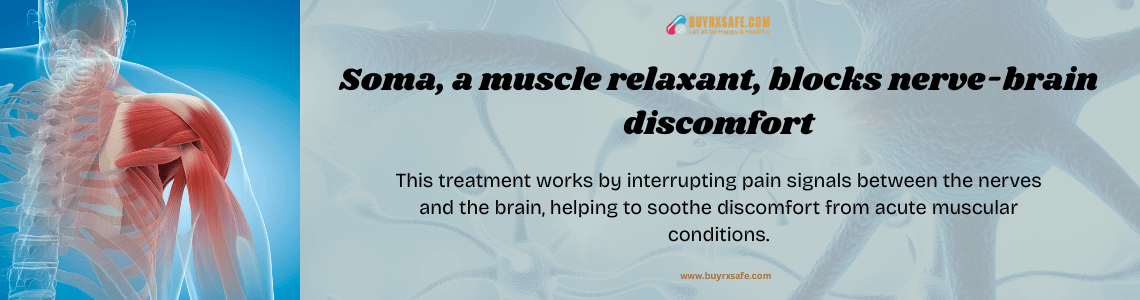
- Key Effect: Reduction of pain is a result of all the above changes in neuronal activity; they stop the pain signal that would otherwise reach the brain from the nerve, in this way practically killing the nerve-to-brain pathway of pain sensation.
- Overall Impact: Soma, acting through the Central Nervous System (CNS), alters the pain sensation, giving rise to noticeable muscle relaxation and sedation. Residents who take this potent medication without a doctor's prescription run the risk of experiencing negative side effects or possibly developing an addiction.
B. Soma Tablets / The Soma Pill
- Forms Offered: Soma, as a medicine for human consumption, is provided in only oral tablet form.
- Dosage Forms: As a rule, it is provided in two strengths of dosages: 350 mg and 500 mg, which is the higher tablet.
- Prescription Requirement: It is categorised as a schedule IV drug with restrictions and hence cannot be given without a proper prescription by a doctor.
- Administration Recommendation: Doctors limit its use to the treatment of severe musculoskeletal pain for 2-3 weeks at the maximum to avoid patients getting addicted to it.
- Dosing Plan: The standard dose for an adult is one 350 mg tablet three times a day plus one at bedtime. The 500 mg strength can be used for a more powerful action.
- Critical Directive: Always exactly comply with your doctor's particular prescription instructions as to the length and frequency of use, for misuse can result in addiction.
C. Efficacy in Blocking Discomfort
Carisoprodol (marketed by its manufacturer as Soma) is efficient in preventing muscle and skeletal disorder pain. It should only be used in the short term. Such that when the condition is not chronic, doctors should prescribe it.
In addition, it uses a dual-action approach by directly working on the muscle. Providing a central analgesic effect to eliminate both spasm and pain.
The drug steadily brings down muscle spasms, leading to fewer involuntary contractions, which are the main contributors to acute pain and stiffness.
This mechanism of action brings about direct muscle pain and discomfort relief, thereby supporting the recovery process through the restoration of mobility and function.
This is a strong medication that should be used only when prescribed by a doctor because the residents who neglect this are likely to become dependent or have adverse reactions.
Highlight: In a nutshell, Soma conducts a two-front war on pain by blocking pain messages in the brain and relaxing overactive muscles at the same time.
Important Considerations and Risks: Soma Side Effects
A. Common Side Effects
- Expect Common Effects: Drowsiness, dizziness, and headaches are often the common effects of the medicine. The sedation will significantly affect your physical coordination and mental reactions.
- First and foremost, safety: not driving, using any machines, and engaging in activities requiring mental alertness until you are completely sure of the drug's effects on you.
- Avoid Intensifiers: The consumption of alcohol or any other central nervous system depressants simultaneously with Soma will unacceptably augment these side effects lethally.
- Monitor and Report: Take notice of your body’s reaction and keep the doctor informed. Even though these effects are quite typical, do not hesitate to report them if they are unusually strong or last long.
B. Serious Side Effects and Risks
- Risk of Dependence: Myths surrounding the drug's therapeutic effects are so strong that consumers regard it as their medical necessity.
- Severe Reactions: Watch for the first signs of anaphylaxis, extremely rapid heart rate (tachycardia), and total sedation or central nervous system (CNS) depression.
- Critical Combination Warning: The impact of Soma is dangerously potent when it is taken along with alcohol or other depressants that affect the brain, leading to a substantial risk of death from respiratory arrest plus overdose.
- Abuse & Overdose Potential: The medication should be under strict control due to its potential for addiction, and thus, proper use is necessary to prevent both misuse and accidental overdosing.
C. The Imperative of Medical Supervision
- A physician should never fail to prescribe Soma. Without a medical examination and a medication created especially to address your problem, it should not be taken.
- Long-term use of this medication is not advised. Your doctor has prescribed it for short-term, acute usage in order to reduce risk. Hence, use it for a short duration.
- Give a complete medical history. You have to talk about all your health conditions. And your medications with your doctor in a very proactive way so that he/she can do a precise risk assessment.